
People inherit rugs, buy them on a posting overseas, carry one home from a shop on a whim, or pick one up because it matched the sofa — and then have no idea what they are standing on. That matters, because the single most expensive mistake in rug ownership is treating an heirloom like a doormat, and the second most expensive is paying heirloom money to clean a doormat. Here is enough to tell the difference.
How a Rug Is Actually Made
Underneath any pile rug there is a grid holding it together. Warps run end to end and carry the tension; the fringe is simply where they run out of rug. Wefts cross them and pin each finished row down. Everything you actually see is attached to that grid, and how it got attached is what separates a rug worth restoring from a rug worth replacing.
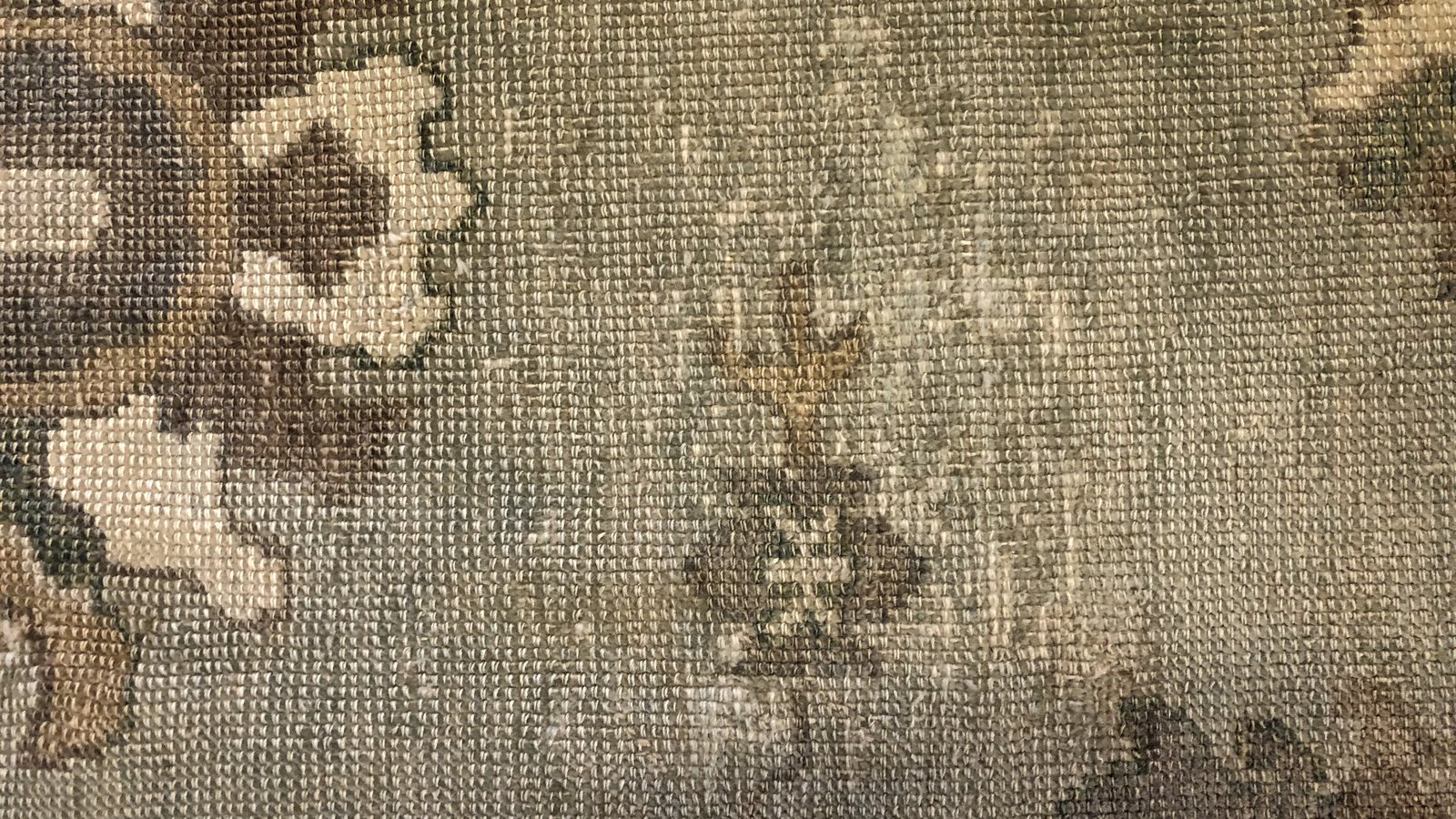
On a hand-knotted rug the pile is added one knot at a time: a short loop of wool or silk wrapped round two warps, beaten down, locked in by the next weft, repeated. Count them across an average nine-by-twelve and you are into the millions. That is the whole explanation for the price, and also for why these things outlive the people who buy them.
Knot types
- Persian (asymmetric) knot — takes a full turn round one warp and slips loosely behind its partner. The looseness is what lets a weaver draw a curve instead of a staircase, which is why it dominates Persian, Indian and Chinese work.
- Turkish (symmetric) knot — takes both warps in an even loop. Tougher underfoot and inclined toward straight lines and angles; standard through Turkey and the Caucasus.
- Tibetan loop knot — one continuous strand looped over a metal rod row by row and then cut open. Quick, recent, and responsible for the thick, uniform pile of nearly every Nepalese rug sold today.
Telling Hand-Knotted from the Rest in Ten Seconds
Flip a corner up and look at the back. There is no faster or more reliable test, and it beats anything printed on a label.
| Construction | The back looks like | What it means |
|---|---|---|
| Hand-knotted | You can read the design through from the reverse, knot by slightly uneven knot, and the fringe runs straight out of the foundation. | Decades to centuries of life. Fully cleanable and fully repairable. Holds value. |
| Hand-tufted | A glued-on cloth backing covering the whole reverse, and a fringe stitched along the ends as a separate piece. | A decade or two of service. The glue holding it together gives out in the end, and announces it. Washable, carefully. |
| Machine-made | A machine-even grid, usually over a stiff synthetic back. The giveaway is that nothing about it varies. | Five to fifteen years of use. Washes very well, cannot meaningfully be repaired, and costs little enough to simply replace. |
| Flatweave (kilim, dhurrie) | No pile at all. Same pattern both sides, reversible. | Durable and light. Needs careful moisture control in cleaning. |
Quick field test: bend the rug back on itself and look at the base of the pile. Knots tied around visible warps mean hand-knotted. A wall of glue means tufted.
Fibres, and What Each One Wants
Wool
The default for good reason. Wool fibres are naturally coiled, so they spring back under furniture; they carry lanolin, which repels soil until you strip it out with harsh detergent; and they are hard to ignite. Wool also holds close to a third of its own weight in water without feeling damp to the hand — excellent for comfort, and a genuine liability in a city that spends four months of the year at a high dew point. That single property is behind most of the musty-rug calls we get.
Silk
Extraordinarily fine, very strong along its length, and capable of detail and lustre no wool can reach. It is also the least forgiving fibre in the house: heat scorches it, prolonged damp weakens it, and a spill left overnight browns it from the inside. Keep silk out of walkways and off the wall the afternoon sun lands on, and never let it near an immersion tank.
Viscose, bamboo silk, art silk
All the same thing under different marketing: regenerated cellulose. It looks like silk in the showroom and behaves like wet paper in real life. Viscose loses most of its strength when saturated, yellows from plain water, and mats permanently underfoot. If you own one, keep it out of dining rooms and entryways, keep it well away from the door people come in from the yard through, and never let anyone wet-clean it conventionally.
Cotton
Usually the foundation rather than the pile, and in flatweaves the whole rug. Cotton absorbs heavily, shrinks if it is dried under tension, and is the first part of a rug to rot after a soaking. It is also the part that suffers in a hundred-year-old house that cycles damp and dry every season, which is why old warps go brittle here. And it is easy to work with, which is why flatweaves are the most forgiving rugs to own.
Jute, sisal and seagrass
Beautiful texture, terrible relationship with water. These plant fibres stain from their own moisture, brown at the edges, and mildew faster than anything else in a damp room. We would not put one in a sunroom, a screened porch or a back hall anywhere in the Midlands, and certainly not over a crawlspace.
Synthetics
Polypropylene, nylon and polyester. Cheap, fade-resistant, and genuinely practical for a lake house, a rental or a family room that opens onto a yard. They crush under furniture and cannot be repaired, but they clean well and cost little to replace — which is the whole point of them.
Midlands Care Notes
Most rug care advice online is written for a cool, dry climate and quietly fails here. Columbia sits at the fall line, where the Piedmont runs out into the Coastal Plain, where the Broad and the Saluda join to become the Congaree. Because the city is inland, low-lying and built on sandy ground, it records some of the highest summer temperatures in South Carolina: the average daily high is about ninety-three degrees in July and ninety-one in August. Roughly forty-five inches of rain falls a year, and the peak of it comes in those same hot months, in afternoon thunderstorms. Adjust accordingly.
Look in the crawlspace before you blame the rug
Most older houses here stand on brick piers over open ground with vents in the foundation wall. The theory is that outside air dries the space out. In practice, on a July afternoon that outside air is far wetter than the soil and joists it meets, so it gives up its moisture underneath your floor and the floor hands it upward. A rug lying on wood over that is being dried on top and wetted underneath for months. If a rug in one particular room keeps smelling, go and look under that room: standing water, missing ground cover or a slumped duct will explain more than anything on the surface will.
Cooling only dehumidifies while it runs
Two habits do most of the damage in Midlands houses. The first is closing the door and shutting the register on a formal room to save on cooling — that room then sits warm, still and humid all summer while the rest of the house is comfortable, and the rug in it is the one that grows things. The second is the big, generously sized system in a newer house: it cools the air fast, satisfies the thermostat, and shuts off before it has run long enough to wring much water out. The house feels cold and the rug is still sitting in wet air. A hygrometer costs very little and will tell you more than your thermostat does.
Get the pollen out, not just off
For about six weeks in spring the pines and oaks put a yellow film over everything outdoors, and it comes in on shoes, on the dog, and through every screen. Pollen is organic matter. On the surface it is a nuisance; once it has worked down to the base of the pile it is food, and it sits there through the wettest, warmest part of the year. Vacuum both faces of the rug through the spring, and treat a wash at the end of pollen season as maintenance rather than as a response to something visibly wrong.
Sand cuts, clay stains — treat them differently
The fall line runs through this city, which means houses on the northeast side sit on fine, hard Sandhills sand and houses to the west and south sit on heavy red clay, and most rugs are carrying some of both. They fail differently. Sand sinks past the surface, lodges against the knots and works like sandpaper every time somebody crosses the room — which is why a rug thins without ever looking dirty. Clay is iron-rich: it leaves a stain rather than a smudge, and scrubbing it while it is wet turns one mark into a rust-coloured halo twice the size. Let clay dry completely, lift what you can, and leave the rest alone. Vacuum with the beater bar off, and vacuum the back of the rug a few times a year.
Wood floors, not tile — and the wrong pad ruins both
Most Columbia rugs sit on finished hardwood rather than tile or stone, and the pad underneath matters more here than people think. A solid rubber or vinyl pad traps the moisture coming up from the crawlspace between the floor and the rug, holds it there all season, and can leave a permanent mark in the floor finish as well. Use a breathable pad, and lift the rug two or three times a year so both the boards and the back of the rug get a chance to dry.
Fresh water is not clean water
There is no salt in the flooding here, and that misleads people into treating a soaked rug as a drying problem. It is not. Creek and river water crosses lawns, driveways, roads and storm drains before it reaches a floor, and what it leaves in the foundation is silt and contamination that has to be flushed out. October 2015 is the reference point: Gills Creek crested at 17.08 feet against a previous record of 9.43 feet, and eighteen dams were breached or collapsed across the state that week. Get the rug up off the floor, do not seal it in plastic, do not point a fan at it, and call somebody. Here is what that restoration involves.
Storage is where good rugs go to die
Every May a great many rugs in this city go into a storage unit or a garage for the summer, and a lot of them come back out ruined. An unconditioned unit in a Columbia August is warm, dark, still and humid, and if the rug went in unwashed it also has a year of organic matter in it. That is the whole recipe for mildew and for moths and carpet beetles at once. Wash the rug before it goes away rather than after it comes back, make sure it is genuinely dry, roll it with the pile facing out, keep it off a concrete floor, and pay the difference for a climate-controlled unit.
Blot spills immediately, and skip the miracle cleaner
Press a white towel straight down and lift — do not rub, which drives the spill into the foundation and fuzzes the pile. Cool water is enough for most fresh spills. Over-the-counter spot removers are usually high-pH and will strip dye out of wool, turning a small problem into a permanent one. Well water on the rural side of the county is often hard enough to leave a mineral ring of its own, so a home spot-clean out there can leave two marks where there was one.
Rotate for the light
A long season of strong sun through a south or west window will take madder red and indigo blue down a band at a time, and it does not come back. Rotate each rug a hundred and eighty degrees a couple of times a year so the fading stays even instead of leaving a bleached stripe where the afternoon light lands.
How Often Should It Be Cleaned?
| Where the rug lives | Professional cleaning |
|---|---|
| Entry, hallway, main living room | Every 12 months |
| Dining room or kitchen-adjacent | Every 12–18 months |
| Bedrooms and low-traffic rooms | Every 2–3 years |
| Homes with pets or allergy sufferers | Every 6–12 months |
| Rooms over a vented crawlspace | Every 12 months, and check the back twice a year |
| Before a rug goes into summer storage | Always, and before rather than after |
| Any rug that has been wet | Immediately |
Is It Worth Anything?
What a hand-knotted rug is worth turns on knot count, the grade and spin of the wool, whether the colour came out of a plant or a laboratory, where and when it was woven, what condition it is in, and — the part nobody quantifies — whether the drawing is any good. Square footage barely enters into it. A small, finely woven, sound antique routinely outvalues a big coarse modern rug several times over.
The two mistakes are opposite ones. People underrate condition: open ends and a strip of moth grazing take a startling amount off the price, and since both are fixable, the repair usually returns more than it costs. And people overrate wear: a rug with an even, honestly walked-down pile and a sound foundation is a far better object than one with crisp corners and a hole in the middle of it.
If you are curious about something you inherited, or something that came back from a posting abroad and has been rolled up in a closet ever since, send photographs of the front, the back, and the ends. We will tell you what it is, roughly where it came from, and whether it is worth restoring — at no charge and with no pressure.
Short Glossary
- Warp — the threads running the length of the rug under everything else; what you call fringe is where they emerge.
- Weft — the crosswise threads that lock each row of knots.
- Pile — the surface you walk on, made of the cut knot ends.
- KPSI — knots per square inch; higher means finer detail and more work.
- Abrash — horizontal shifts in shade where the weaver moved to a new dye lot. Evidence of hand dyeing, not a defect.
- Selvedge — the bound long edges, which are all that stops the rug letting go sideways.
- Dew point — the temperature at which air gives up its moisture; the number that actually predicts whether a rug can dry.
- Hygroscopic — describes urine residue and salts: they pull moisture out of the air and hold it in the fibre.
- Dry rot — cotton warps and wefts broken down by months of damp; the reason a wet rug is an emergency rather than an errand.
- Blocking — stretching a washed rug back to square while it dries.