Torn edges, missing fringe, moth grazing along the side that lives under the dining
table, a corner the puppy decided was a chew toy, or a rug that spent a night in creek
water. Most of it is fixable by hand.
Patching a rug and repairing one are different trades. A repair puts the rug back
together in the order it was built: warps and wefts first, then knots tied at the same
density in wool matched for fibre, weight and dye lot. Get that right and the mended
area takes wear at the same rate as the field beside it, which is the only reason a
repair stays invisible instead of surfacing as a shiny patch two winters later.
None of it is quick. A reweave is priced and planned in square inches, because a pair
of hands at a loom is still the only thing that does the job. What that buys you is
range: very little that arrives here is actually beyond saving, whatever the person
carrying it in has already decided.
Assessment is free and the verdict is blunt. Where the bill would run up against what
the rug is worth, you will hear that first, and we would rather lose the work than
quietly spend your money on it.
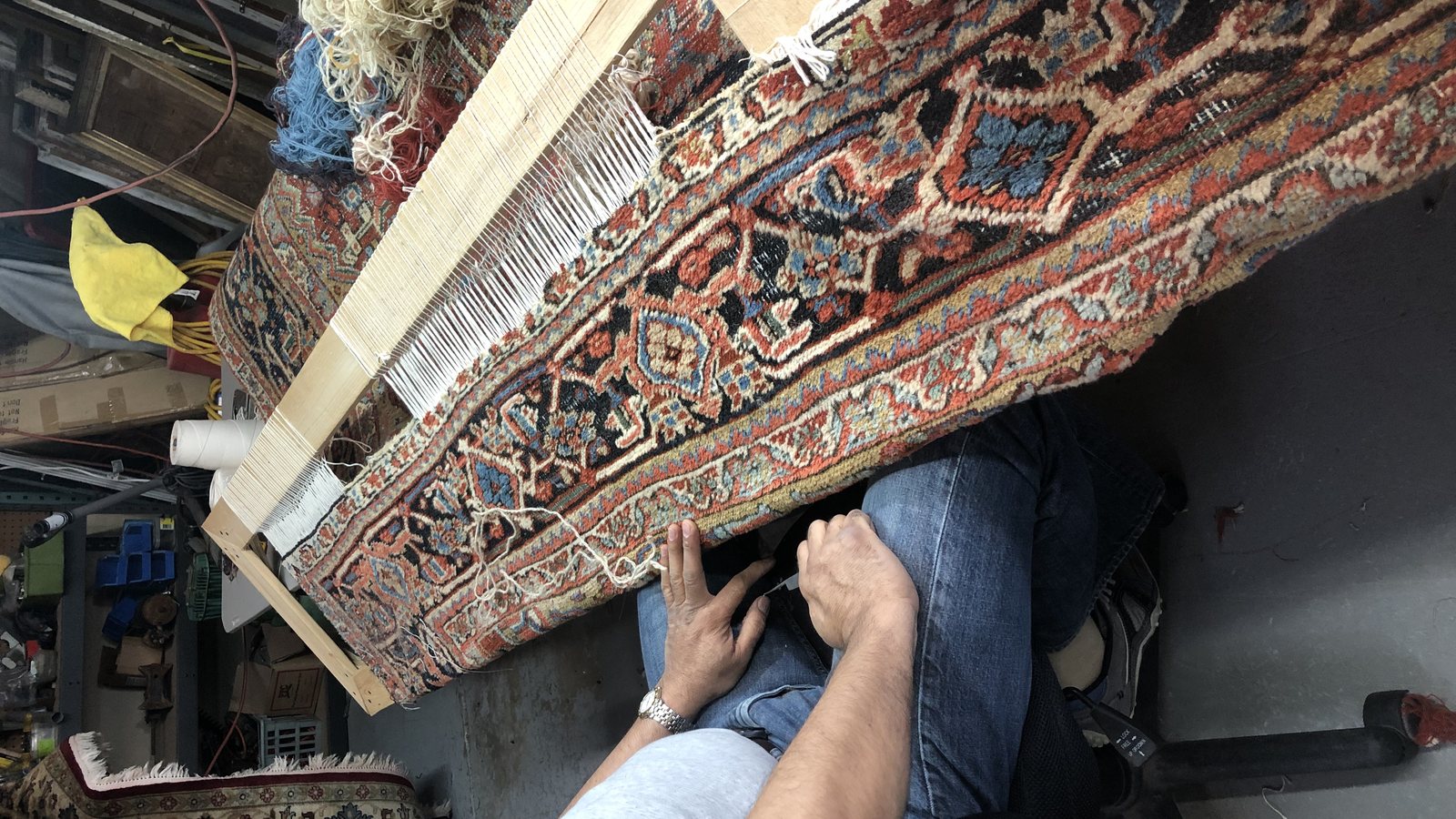
Hand reweaving: matched wool knotted back into an oriental rug foundation.
What We Fix
Repair & Restoration Services
From a short fringe tidy to rebuilding a foot of missing border.
Fringe Repair & Replacement
Fringe is not trim — it is the warp of the rug coming out of the end. Losing it
means the rug is coming undone from the edge inward. The ends get secured, missing
warps rebuilt, and fringe re-knotted or replaced to match what was there.
Edge Binding & Serging
The wrapped side cords absorb everything a vacuum head and a chair leg can do to a
rug, and when one splits the knots next to it start walking free. Sides are rewrapped
by hand in matched wool before that spreads.
Reweaving & Hole Repair
Scorches, splits and areas worn through to the backing are put back a knot at a time.
Warp and weft are rebuilt first so the hole has something to sit in; only then does
the pile go back, matched for colour, fibre and knot count.
Moth Damage
Moth larvae eat wool from underneath, so by the time bare foundation shows there is
usually an active problem. We treat the infestation, then reweave the grazed areas.
The classic find here is the rug under a dining table in a room that is kept shut
and closed off from the cooling all summer — dark, still and undisturbed is
exactly the condition they want.
Pet Damage
Corners treated as chew toys, edges opened up by claws, and dye burnt out from
underneath by urine. Decontamination comes first — there is no point reweaving
into a contaminated foundation — then structure, then colour where the dye is
gone for good.
Colour & Dye Correction
Sun-bleached bands where the afternoon light lands, bleach spots, iron staining left
by red clay, and dye that migrated during a bad cleaning or a soaking. Colour is
rebuilt by hand where the fibre is still sound.
Resizing & Reshaping
Narrowing or shortening a rug to suit a room, and pulling a buckled one back to
square on the blocking frame. A cut edge gets a finished side cord, so the result
looks like a decision rather than an accident.
Backing & Foundation Repair
Delaminated latex under a tufted rug, cotton warps gone brittle with age, and rugs
that will not sit flat because the structure underneath has stretched or torn.
Nothing cosmetic happens until the frame of the rug is sound again.
Rug Pads & Prevention
A great many of the repairs we do could have been avoided by a decent pad. We fit
breathable, non-adhesive pads sized to the rug — which matters most on a wood
floor over a crawlspace, where a solid rubber pad seals in the moisture rising from
below and holds it against the foundation right through the season.
Wet Rug Service
Flood, Creek Water & Water Damage Rug Restoration
A creek out of its banks, a thunderstorm the storm drains could not take, a supply
line behind a washing machine, or a crawlspace that filled and pushed damp up through
the floorboards. The rug on that floor is now on a clock.
Why speed matters more than anything else
Wool survives being wet surprisingly well. What it does not survive is staying wet.
In a warm room mould establishes in a saturated foundation in roughly forty-eight
hours, and once it is at the base of the pile you cannot vacuum, spray or air-dry it
back out. From May to September the rooms in this city are always warm enough.
Meanwhile unstable dyes start migrating, cotton foundations begin to rot, and
whatever the water picked up on the way in is curing into the rug.
Creek and river water is worse again. It carries silt, sewage and whatever was on
the lawns, driveways and roads it crossed, and along Gills Creek and the Congaree
that is a documented local risk — in October 2015 Gills Creek crested at 17.08
feet against a previous record of 9.43 feet, eighteen dams failed across the state,
and Columbia went onto a boil-water advisory. Contamination has to be washed out in
immersion. A fan pointed at a wet rug is not restoration: it dries the surface, locks
the contamination into the foundation, and produces a rug that smells fine for three
weeks and then does not.
What to do before we arrive
Lift it clear of the wet floor and move the furniture off it — a wooden leg standing on damp wool bleeds its finish into the pile within hours.
Whatever you do, do not seal it in a bag or roll it up tight. A wrapped wet rug is an incubator; leave it loose and open to the air.
Take pictures while it is still lying wet where it happened, before anything gets moved. That is the evidence a claim runs on.
Do not hose the silt off and leave it. Half-washing sets the contamination and complicates the real wash.
Open the crawlspace access and look. If the ground under the house is standing wet, the floor above it will not dry and neither will the rug.
The restoration sequence
Priority collection. A soaked rug goes to the front of the queue ahead of routine washing wherever the week allows it.
Category assessment. Clean supply water, grey water and creek or flood water are three different jobs, and which one you have decides the method.
Extraction and full flush. Silt and contaminants are washed out of the foundation, not sealed in behind a dry surface.
Antimicrobial treatment. Worked through the whole rug from both faces while it is still wet, before any drying begins.
Monitored flat drying. Filtered air moved across the rug flat, with a meter on it until the readings stop falling. Nothing leaves damp in the middle.
Dye-bleed correction. Where a colour has run into its neighbour during the soaking, it gets drawn back out as far as the fibre will let it go.
Structural repair. Once the rug is dry and stable, rotted warps and missing pile go back on the loom.
Claim documentation. A written condition report with photographs, put together in the form a carrier will accept.
Send pictures of the damage, or we collect the rug at no charge anywhere in Richland and Lexington counties.
2
Assessment & Quote
Damage is measured and mapped, materials identified, and you get a written price with the options laid out. Nothing begins until you say yes to one of them.
3
Clean First
The wash comes before the loom. New wool set into a soiled field is a clean patch in a dull rug, and it only gets more obvious with age.
4
Materials Matched
Replacement wool is chosen against the original for fibre, weight and dye lot, then laid on the field in daylight before a single knot is tied.
5
Hand Repair
Warp and weft go back first, then knots at the original density, then the new pile is sheared down level with what surrounds it.
6
Final Check & Return
Groomed out, checked against the photographs taken at intake, and carried back in and laid down for you.
Questions
Repair & Restoration FAQ
Is my rug worth repairing?
You will hear the answer before anyone picks up a needle. Repair is worth doing when
the rug means something — in money or otherwise — and the foundation
underneath is still sound. Once the bill starts approaching the value of the rug, we
say so out loud instead of letting the invoice grow.
How long does rug repair take?
It comes down to how many square inches have to be rebuilt, since every one of them
is tied by hand. The written quote carries a timeline with it, so you know before you
agree. Wet rugs are the exception — they start the moment they arrive, because
with those the clock is the whole problem.
Can a rug that took creek or flood water be saved?
Often, yes — more often than a first look suggests, and more often than the
person standing in the room believes. What decides it is how quickly the rug is
flushed rather than how bad it looked on the day. Fresh flood water carries silt and
contamination that has to come out of the foundation in immersion, and mould
establishes in a saturated foundation within roughly forty-eight hours in a warm
room. Ask before you put anything on the kerb.
Will the repair be visible?
Once the pile is combed out, a good reweave takes some finding. The wool is matched
for fibre, dye lot and knot count, and because the warps and wefts go back before any
pile does, the mended patch wears down at the same rate as everything around it
instead of sinking below it or standing up out of it.
Do you work with insurance claims?
Yes. The rug is photographed on arrival and at each stage after that, and you are
given a written record of the damage, what was done about it and what it means for
the value — in a form you can hand straight to the carrier.
My rug ripples and will not lie flat. Can that be fixed?
Usually it can. Ripples come from a foundation that has gone out of true, a bad dry
somewhere in the rug's past, or years spent on a pad with no support in it. The rug is
washed, then blocked square under tension while it dries, and the warps and wefts are
repaired wherever they have stretched or given way.
Send Us a Photo. We Will Tell You Straight.
Every repair is assessed free, and you get an honest answer about whether the work is worth the money.